🧠 Algorithm
RamParILS implements Iterated Local Search (ILS) for automated algorithm configuration. The goal is to find the parameter setting of a target algorithm that minimises runtime or a numeric quality cost on a set of training instances. Both objective modes are minimisation; wrappers for maximisation problems must transform utility into a cost.
🔄 Iterated Local Search
ILS alternates between two phases: local search finds a local optimum in the configuration
space, and perturbation escapes it by applying a random walk. Starting from an initial
configuration (typically the parameter file’s declared defaults), local search explores the
neighbourhood one parameter at a time, greedily accepting any neighbor that improves performance.
When no improving neighbor exists, perturbation applies perturbation_strength random steps to
escape the local optimum, and the cycle repeats until the tuner timeout expires.
The neighbourhood of a configuration is all configurations that differ in exactly one parameter. For a space with P parameters and average domain size D, each configuration has at most (D−1)×P neighbors. RamParILS submits neighbours to a bounded worker pool and accepts the first fully evaluated improvement. The wall-clock cost still depends on neighbourhood width, fidelity, worker count, cache hits, and solver runtimes.
The perturbation draws uniformly from the neighbourhood, not from the parameters, so a parameter with a large domain is perturbed more often than a boolean one: a five-valued parameter offers four of the neighbours a boolean offers one.
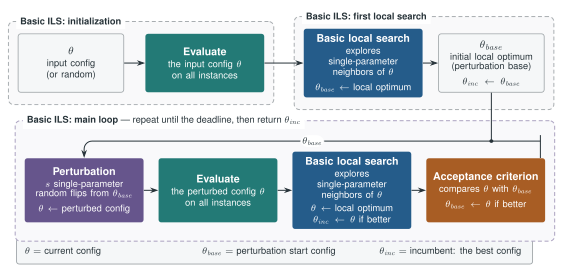
The figure is approach: basic, where every candidate is scored on the whole
instance set; FocusedILS wraps the same loop in a growing prefix, described below.
Three configurations are in play at once, and keeping them apart is most of understanding the search. θ is the round’s candidate. θ_base is the point each perturbation starts from — the ILS home base. θ_inc is the incumbent: the best configuration seen, and what the run returns.
Note where each is written. The local search sets θ and, if the descent improved on it, θ_inc; the acceptance criterion sets θ_base. Only θ_base is perturbed, so the incumbent improving does not by itself move the search: once the home base stops moving, every later round samples the same ball around a fixed point. That asymmetry is the reason for the knobs in the next section, and the source of the failure they were added to fix.
🪂 Escaping a frozen home base
The acceptance criterion only ever replaces the home base with an at-least-as-good local optimum, so on its own it cannot move the search uphill: once a strong local optimum is found, every later round perturbs the same point and the run degenerates into repeated sampling from a fixed ball. Four optional knobs address this. All are off by default, so a run that does not set them behaves exactly as before they existed.
| Field | What it does |
|---|---|
acceptance_tolerance | Accept a worse local optimum as the home base while it stays within this relative margin of the incumbent. Measured against the incumbent and not against the home base on purpose: against the home base the margin compounds, and the home base can then drift downhill without limit. |
restart_failures | Restart the home base after this many consecutive rejected local optima. Adapts to however many rounds the budget turns out to allow, which matters when a run gets tens of rounds rather than thousands. |
restart_probability | ParamILS’s p_restart: restart with this probability after each round. At the classic 0.01 it is calibrated for thousands of rounds — over 50 rounds it fires half a time. |
random_probes | ParamILS’s R: probe this many random configurations before the first descent, stepping to any that beats the starting configuration. Defaults to 0: RamParILS’s primary use is specializing a strategy supplied by the caller, so the supplied configuration is the starting point unless asked otherwise. A run given no configuration at all starts from a single random draw, and these probes extend that. |
restart_target decides where a restart lands: incumbent perturbs the best configuration found
so far by restart_strength steps (default 2 × perturbation_strength), while random draws a
uniformly random configuration, which is what ParamILS does. Restarts are logged so they can be
told apart from ordinary acceptance when a run is read back:
ils: restart: reason=stagnation target=incumbent strength=10 score=0.481578 instances=473 after 10 rejected local optima
⚖️ BasicILS vs FocusedILS
The approach field selects the ILS variant.
BasicILS (approach: basic) evaluates candidates on the complete training-instance set
before comparing their aggregate scores.
FocusedILS (approach: focused, the default) uses progressive global fidelity. Candidates
are compared by their aggregate score on the current prefix of the training-instance list. When
the incumbent survives a challenge, the prefix grows by fidelity_step until all instances are
used. A challenger must have a strictly lower score at the current fidelity to replace the
current configuration.
RamParILS starts FocusedILS at initial_fidelity instances per configuration and increases that
global fidelity by fidelity_step, up to the number of available instances. With W workers and
fidelity F, the current scheduler can approximately evaluate ceil(W/F) different neighbors at
once. Increasing F therefore uses more workers on instances of the same neighbor and reduces
speculative work on neighbors that may become irrelevant after the first improving move.
Fidelity always uses the first F entries in the supplied instance list. The list is not shuffled, so its early prefixes should be reasonably representative of the complete training set.
A score is only meaningful relative to the prefix it was measured on — different fidelities are different objective functions, and comparing across them is meaningless. Two configurations outlive a fidelity increase: the incumbent, and the local optimum the next perturbation starts from (the ILS home base). Both are re-measured on the new prefix whenever the fidelity grows, so every comparison the ILS makes is between scores taken on the same instances. Each increase is logged as
ils: n_runs increased to 64/1753 incumbent_score=0.456619 home_base_score=0.456619
The home base is usually the incumbent, in which case the second measurement costs nothing.
Home-base replacements are logged too, one line each, with the parameter diff against the previous home base rather than a full configuration block — it can change every round:
ils: new home base: hash=bd4315273a9356dd score=0.025000 instances=4 changes: alpha: 3 -> 2; beta: a -> b
Replacements with no effective change (a differing value on a parameter whose guard is off) produce an empty diff and are not logged.
This matters more than it may appear. Prefix means drift as the prefix grows — typically upward,
if the early instances are cheaper — while the acceptance criterion is monotone: the home base is
only ever replaced by something that beats it. A home base left on an old, smaller prefix
therefore holds an optimistically low bar that the only mechanism able to update it can no longer
clear, and the perturbation centre freezes for the rest of the run. ParamILS avoids this by
storing a score per fidelity level for every configuration and always comparing two states at
their common level (isBetterWithLesserDetail in param_ils_2_3_run.rb); RamParILS keeps one
score per state and re-measures instead.
Random (approach: random) is ParamILS’s pert_rand: it uses all instances from the start,
but each round begins from a fresh uniformly random configuration and the acceptance criterion is
skipped entirely, so nothing carries over between rounds except the incumbent. That makes it a
random-restart baseline to measure an iterated local search against, not a tuning mode to prefer.
Restarts are inert under it, since every round already restarts.
✂️ Adaptive capping
Adaptive capping (pruning, bound_multiplier) abandons an evaluation once the configuration has
spent the entire budget that beating the incumbent would allow:
partial_sum > bound_multiplier × incumbent_score × n_instances
Costs never go down, so passing that budget proves the final mean exceeds the bound. Capping is therefore exact — it never discards a configuration that would have been accepted — and it fires at the earliest point where the proof exists.
Pick the multiplier against the objective’s ceiling, not in the abstract. Under a runtime
objective no instance is charged more than cutoff_time, so with B = bound_multiplier × incumbent_score and C = cutoff_time, capping cannot fire at all unless B < C, and when it can,
no cap is possible before B / C of the instance set — spending a budget of B·N takes at least
that many instances. With an incumbent of 0.478 at a 1 s cutoff, multiplier 2.0 gives B/C = 0.96:
nothing is pruned before 96% of the set, which is indistinguishable from pruning: false. The same
2.0 at a 10 s cutoff with an incumbent of 2.95 gives 0.59 and prunes normally. Express the intent as
a fraction of the ceiling and the multiplier follows.
A capped score is a lower bound, not a score, and is logged as one:
ils: bls local optimum score=>2.698475 (312/473)
It is a mean over the instances that finished first — the fastest — so it understates the true mean. Never compare two capped scores with each other: each covers a different, differently biased prefix.
Under overall_obj: median the cap tests a statistic the run does not score — it always sums.
Prefer pruning: false there.
A run ends with an account of what the search actually got to do:
ils: summary rounds=79 searched=8 gated=71 incumbents=2 evals=2612 capped=2489
A gated round is one whose starting configuration was capped and which then accepted no move: the bound hid every neighbour, so the round produced no search. Worth reporting whenever two approaches are compared — the bound is relative to the incumbent, so it prunes a small perturbation and a fresh random draw at very different rates, and a final-score comparison alone hides that.
📈 Iterative deepening
Iterative deepening (iterative_deepening: true) runs ILS in multiple phases with an exponential
schedule rather than a single run. Early phases use a small fraction of the training instances
and a short per-run cutoff — just enough to quickly filter the search space and find a good
starting point. Later phases gradually increase the instance count, cutoff time, and per-phase
budget, refining the best region found so far. The incumbent from each phase seeds the next,
so early exploration and late refinement share information.
Three growth factors control the schedule:
| Field | Controls | Effect of larger value |
|---|---|---|
lambda_n | geometric instance-count growth | larger values use more instances in early phases |
lambda_c | geometric cutoff growth | larger values use longer cutoffs in early phases |
lambda_t | geometric cumulative-deadline growth | larger values give earlier phases later deadlines |
All three default to 0.5, giving an approximate geometric doubling schedule.
The timeout values are cumulative deadlines measured from the start of
iterative deepening, not independent budgets added together. Each phase gets
the time remaining before its deadline.
Iterative deepening is most useful when the training set is large (hundreds of instances) and the cutoff time is long (tens of seconds), making a full-budget single run prohibitively slow at the start.